In 2022, if you wanted the cheapest usable ham radio, you bought a Baofeng. The UV-5R was the obvious answer — not because it was exceptional, but because nothing else came close at that price point. It worked, it was everywhere, and if you broke it you ordered another one without crying about it.
In 2026, that calculus has changed. The Quansheng UV-K5 lands at the same $20–30 price, fits in the same jacket pocket, and on paper reads like a completely different class of radio. The question is whether that paper translates to real-world value — and whether the UV-5R’s years of polish and ecosystem still make it the smarter buy for most hams.
I’ve used both. Here’s the honest breakdown.
At a Glance
| Feature | Quansheng UV-K5 | Baofeng UV-5R |
|---|---|---|
| Street price | ~$20–30 | ~$20–30 |
| Receive coverage | ~18 MHz – 1.3 GHz (with firmware) | 136–174 MHz, 400–520 MHz |
| Transmit bands | 2m / 70cm (ham only) | 2m / 70cm |
| Output power | 5W | 5W (8W on some variants) |
| Hackable firmware | Yes — Egzumer fork is excellent | No |
| CHIRP support | Yes (improved significantly) | Best-in-class |
| Accessory ecosystem | Growing, but limited | Enormous |
| Community support | Active (r/uvk5, GitHub) | Massive, long-established |
| FCC Part 97 use | Yes (ham use only) | Yes (ham use only) |
The Baofeng UV-5R: Reliable, Proven, and Boring in the Best Possible Way
The UV-5R has been in continuous production since 2012. That’s not a typo. The same basic radio that sold for $35 in 2012 is still on Amazon shelves today for less than that, adjusted for inflation. At this point the UV-5R is less a radio and more an institution.
What you get is a straightforward dual-band HT covering VHF (136–174 MHz) and UHF (400–520 MHz). The receiver is basic but functional. The transmitter is reliable. The menus are clunky but documented in approximately nine thousand YouTube tutorials. If you get stuck, someone has solved your exact problem on Reddit already — probably in 2014.
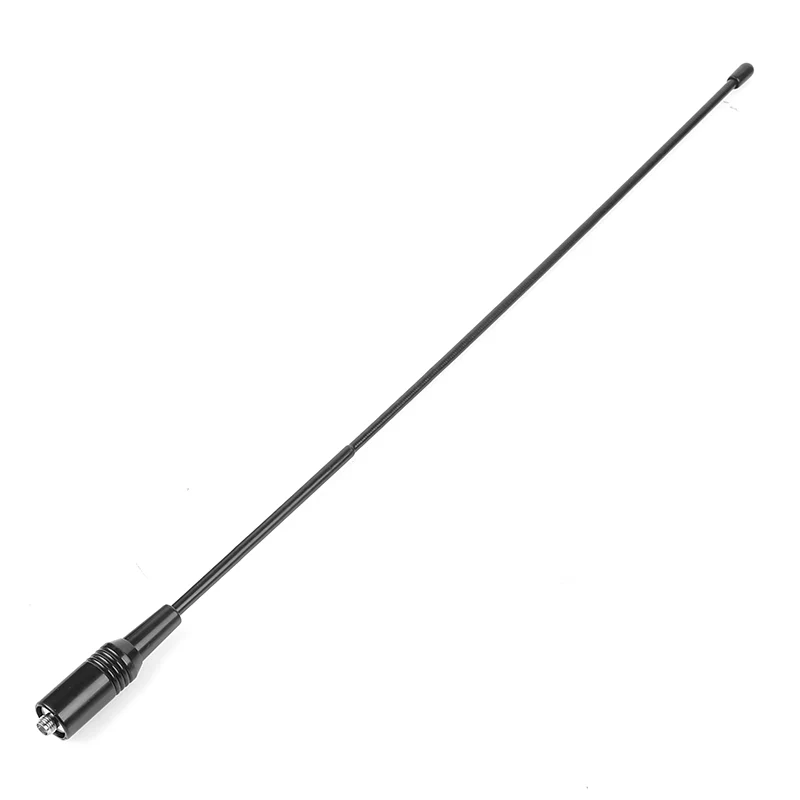
The real strength of the UV-5R is everything around the radio itself. The accessory ecosystem is staggering. You can buy extended batteries, slim batteries, speaker-mics, holsters, tactical cases, programming cables, and replacement antennas from dozens of vendors. The Nagoya NA-771 screws right on and is the first upgrade virtually every UV-5R owner makes. Kenwood-style connector accessories are nearly universal across the lineup.
CHIRP support is best-in-class. The UV-5R was one of the first radios supported by CHIRP and it has received years of refinement. Programming it takes about ten minutes if you’ve never done it before, and five minutes once you have.
The weakness is real, though. The UV-5R receive is limited to its two bands. You can’t tune below 136 MHz. You can’t listen to aircraft on 121.5 MHz. You can’t scan HF shortwave. You can’t receive the NOAA weather satellite downlinks without significant effort and a separate setup. The radio does what it does and nothing more, and there is no firmware community coming to expand those capabilities. What shipped in 2012 is more or less what you have today.
There’s also the FCC compliance history, which is worth a brief mention. The UV-5R has had a complicated relationship with Part 15 and Part 90 certifications over the years. For ham radio use under Part 97, this is largely a non-issue — hams are licensed operators using a licensed radio on designated bands. But it’s worth knowing the context if you’re ever asked about it.
Current pricing and availability: check the UV-5R deal page. There’s also frequently a solid discount on open-box UV-5R units if you don’t need retail packaging.
The Quansheng UV-K5: The Hacker’s Choice
The UV-K5 shipped in 2023 and immediately attracted attention from the kind of hams who were already flashing custom firmware onto other radios and seeing what would break. The hardware was interesting: an ESP32-based platform (some later batches use NRF variants) with a receive chain that physically covered a much wider spectrum than the stock firmware exposed.
That last part is the whole story.
The stock UV-K5 firmware is fine. It’s a basic dual-band HT, similar territory to the UV-5R. Install the Egzumer firmware fork, however, and the radio transforms into something else entirely. The receive range opens up to roughly 18 MHz to 1.3 GHz. You get AM reception for aircraft communication. You get FM broadcast. You get shortwave reception. Depending on the specific variant and firmware build, you can get rudimentary SSB and CW reception. All of this on a radio you paid $25 for.
The r/uvk5 subreddit is one of the more active communities in budget radio right now. The Egzumer fork on GitHub has been maintained actively, with regular releases adding features and fixing bugs. This is not abandonware — it’s a genuine ongoing development community. Flashing the firmware is not complicated: download the tool, connect a USB-C cable, follow the steps. Most people complete their first flash in under fifteen minutes.
The practical implications are significant for the right user. If you hold a Technician license and you’re mostly using the radio on local 2m repeaters, the wide receive range is a bonus. But if you’re a General or Extra class operator who also wants to listen to HF while out of the shack, or you want to pick up ATIS and tower comms at the local airport, or you want to receive NOAA weather satellite APT transmissions — the UV-K5 at $25 is genuinely hard to argue against.
Transmit remains limited to 2m and 70cm ham bands regardless of firmware. This is the correct behavior and worth emphasizing: the Egzumer firmware does not unlock illegal transmit frequencies. It expands receive coverage. The transmit limitation is both a regulatory and hardware constraint.
The weaknesses are real and worth naming clearly. The accessory ecosystem is thinner than the UV-5R’s, though it’s growing. Early production batches had reported QC issues — loose antenna connectors, inconsistent audio levels — and while these appear to have improved, the UV-5R’s decade-plus manufacturing consistency is a real advantage. The firmware community is excellent but it is a community project, not an official support channel. If you flash the Egzumer fork and something goes wrong, you are on GitHub issues and Reddit, not calling a support hotline.
Real-World Use Cases: Which One Should You Buy?
You’re a new Technician who just wants to hit local repeaters. Buy the UV-5R. The tutorials are everywhere, CHIRP support is bulletproof, and you’ll spend zero time troubleshooting. The goal is getting on the air, not tinkering.
You’re tech-curious and want to listen to aircraft, weather satellites, or shortwave. Buy the UV-K5. Flash the Egzumer firmware the same afternoon. The wide receive coverage alone justifies the choice and you’ll have a legitimate tool for monitoring well beyond ham bands.
You want the widest possible accessory compatibility. Buy the UV-5R. Extended batteries, speaker-mics, antenna options — the ecosystem is simply more developed. If you’re building out a go-bag or want drop-in spares, the UV-5R infrastructure wins.
You want to experiment with firmware and learn SDR-adjacent concepts. Buy the UV-K5. The community is active, the project is well-documented, and you’ll learn something in the process.
You’re buying a backup radio for a go-bag. Buy whichever is cheaper that week. At this price tier, either radio is a legitimate emergency backup. Price-match them both and grab the lower number.
Programming Both Radios
Both the UV-K5 and UV-5R support CHIRP, the de facto standard for open-source radio programming software. If you haven’t used CHIRP before, the workflow is: download and install, connect the radio via programming cable (USB-C for the UV-K5, older micro-USB or proprietary for the UV-5R), pull the current config from the radio, edit your channels, and write it back.
CHIRP’s UV-5R support has been refined over more than a decade and is essentially flawless. UV-K5 support has improved significantly since 2023 and is now reliable for standard operations — earlier CHIRP versions had some compatibility gaps with the K5, but that has largely been resolved in current releases.
The UV-K5 also has its own dedicated firmware downloader tool, which is the utility you’ll use if you’re flashing the Egzumer fork. It’s a separate tool from CHIRP and handles the firmware side independently of channel programming. Many UV-K5 owners use both: the firmware downloader for firmware updates and Egzumer’s own companion app or CHIRP for channel management.
One practical note on cables: the UV-K5’s USB-C connection is a genuine quality of life improvement over the UV-5R’s programming cable situation. No proprietary cable to lose, no driver headaches on most systems.
The Verdict
If you’re willing to spend fifteen minutes flashing firmware, buy the Quansheng UV-K5 in 2026. The capability per dollar is not close. Wide receive coverage from 18 MHz to 1.3 GHz, an active firmware development community, and the same transmit performance as the UV-5R — all at the same price point. The UV-K5 is the more interesting radio and, for most technically inclined hams, the more useful one.
If you want zero configuration friction, the largest possible accessory ecosystem, and the most tutorial coverage of any budget HT ever made, buy the Baofeng UV-5R. It earned its reputation. The fact that it’s still the default recommendation for new hams in 2026 after fourteen years of continuous production says something real about its staying power.
What the UV-5R is not, anymore, is the automatic answer. The Quansheng UV-K5 changed that. At identical price points, the UV-5R now has to justify itself on ecosystem and simplicity — and for a significant portion of buyers, especially those even mildly curious about what’s in the spectrum beyond 2m and 70cm, it can’t.
Check the current price on the Baofeng UV-5R deal page and compare. And if you’re still deciding between budget HTs, our full budget HT guide for 2026 covers the complete field, including options above the $30 floor where things get even more interesting.
If the UV-K5’s wide receive capability pushes you toward wanting a dedicated software-defined radio, see our SDR dongle rankings — the RTL-SDR V4 picks up where the UV-K5 leaves off on receive performance and adds decoding capabilities the UV-K5 can’t match.
Frequently Asked Questions: UV-K5 vs UV-5R
Is the Quansheng UV-K5 legal to use on ham radio frequencies?
Yes. The UV-K5 transmits on the 2-meter (144–148 MHz) and 70-centimeter (420–450 MHz) amateur bands where it is legal to operate with a valid FCC Technician license or higher. The extended receive range (18 MHz–1.3 GHz with Egzumer firmware) is receive-only and does not require a license. Transmitting outside of licensed amateur bands on either radio is illegal under FCC regulations regardless of firmware.
What is the Egzumer firmware for the Quansheng UV-K5?
Egzumer is an open-source firmware replacement for the UV-K5, available on GitHub and installable from a browser without any special tools. It unlocks extended receive coverage from 18 MHz to 1.3 GHz (including AM aircraft band, shortwave, and weather satellite frequencies), adds NOAA weather channel presets, improves the built-in spectrum analyzer, and fixes several bugs in the stock firmware. Installation takes approximately 5–10 minutes.
Can the Baofeng UV-5R receive aircraft (airband) frequencies?
No. The UV-5R receives only from approximately 136–174 MHz and 400–520 MHz and cannot tune AM signals in the aircraft band (108–137 MHz). The Quansheng UV-K5 with Egzumer firmware can receive the AM airband — a significant practical difference for operators who want air traffic monitoring capability without a separate scanner.
Are accessories interchangeable between the UV-K5 and UV-5R?
Partially. Both radios use a 2-pin Kenwood-style connector for earpieces and speaker-microphones, so most UV-5R accessories will physically fit the UV-K5. However, the UV-K5 uses its own battery form factor and charges via USB-C built into the radio, so UV-5R batteries, cases, and extended battery packs are not compatible.
Which radio has better CHIRP programming support?
The Baofeng UV-5R has significantly better CHIRP support — it has been in the CHIRP database for over a decade and every feature works reliably. The UV-K5 has CHIRP support but it is newer and some firmware versions have compatibility quirks. UV-K5 users often use the dedicated UV-K5 web programmer tool as an alternative to CHIRP for channel management.
Whichever radio you land on, the first upgrade is the same: swap the stock rubber duck for a Nagoya NA-771. Both radios underperform their potential on the factory antenna, and the NA-771 is a $10–15 fix that makes a noticeable difference on receive and transmit.